
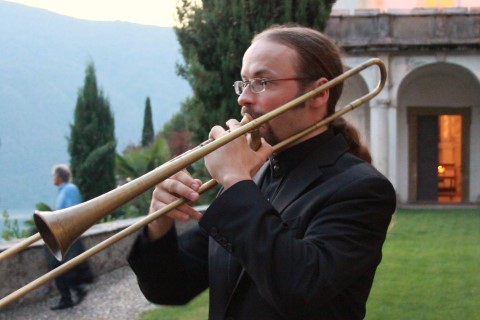
 Lorsque, pendant sa première année de Bachelier au Conservatoire d'Oberlin aux États-Unis, il dénicha une sacqueboute dans la collection de trombones de Jim DeSano, Nathaniel Wood - natif de Syracuse, dans l'état de New York - découvrit qu'il pouvait concilier son amour de l'histoire et sa passion de toujours pour la musique. This led to three years of exploration in performance practice classes, early chamber music, and Renaissance polyphonic singing in the Collegium, avec notamment pour professeurs Lisa Crawford, Steven Plank, Richard Cheetham et Alison Melville. Ces expériences, auxquelles s'ajoutèrent des cours d'été avec Wim Becu et les membres de Piffaro, led him to then pursue first a Masters degree in performance practice at Case-Western Reserve University under the tutelage of Ross Duffin and Greg Ingles, and then as a Fulbright/Ratner Foundation Scholar to the Schola Cantorum Basiliensis.
At the Schola, he expanded his repertoire as far back as the fourteenth century, and forward to the Romantic period, studying historical trombones with Charles Toet, plectrum lute and medieval performance practice with Crawford Young, solmisation and sixteenth-century performance practice with Anne Smith, and performing rhetoric with Anthony Rooley. His particular interests focus on the various activities of Renaissance wind bands in both secular and sacred contexts, and the virtuoso chamber music of the seventeenth century.
Interprète versatile, he is equally at home across the wide spectrum of Renaissance, Baroque, Classical and modern trombones, as well as the medieval busine and various slide and natural trumpets.
Vivant aujourd'hui à Fribourg en Allemagne, Nathaniel joue avec plusieurs ensembles de musique ancienne, dont Concerto Palatino, Les Haulz et les Bas, Mediva, Le Miroir de Musique, L'Arpa Festante München, New Century Baroque, Ensemble COMBASSAL et I Fedeli. Il est également co-fondateur des ensembles d'alta capella Mandragora et L'alta bellezza, et membre actif de Concerto Scirocco et de TRUMMET.
En parallèle à ses activités d'instrumentiste, Nathaniel s'est lancé dans la voie his performing work, he has also pursued a growing interest in instrument making, collecting, measuring and studying a variety of historical brass instruments, attending symposia, frequenting the workshop of Rainer Egger, d'abord comme testeur d'instruments, puis comme interne, working with harpsichord maker and restorer David Ley, and participating in instrumentmaking courses with Robert Barclay, Michael Münkwitz et Geert Jan van der Heide, avant d'ouvrir son propre atelier de cuivres historiques.
Nathaniel is an advocate of pushing the boundaries of historical performance, working closely with all-gut, equal tension string players including Margreet van den Heyden et Caroline Ritchie, various natural (unvented) trumpet players, and the ensemble Chordae Freybergensis, which is dedicated to exploring the repertoire of the late-Renaissance instruments de la cathédrale de Freiberg (Saxe). He prefers to take the risk of experimenting practically with new discoveries over playing it safe, and favors flexibility and historical accuracy to a one-size-fits-all approach, both stylistically and regarding choice of setup.
He is furthermore in demand as an instrumental teacher and ensemble coach, working with a range of modern and historical ensembles.